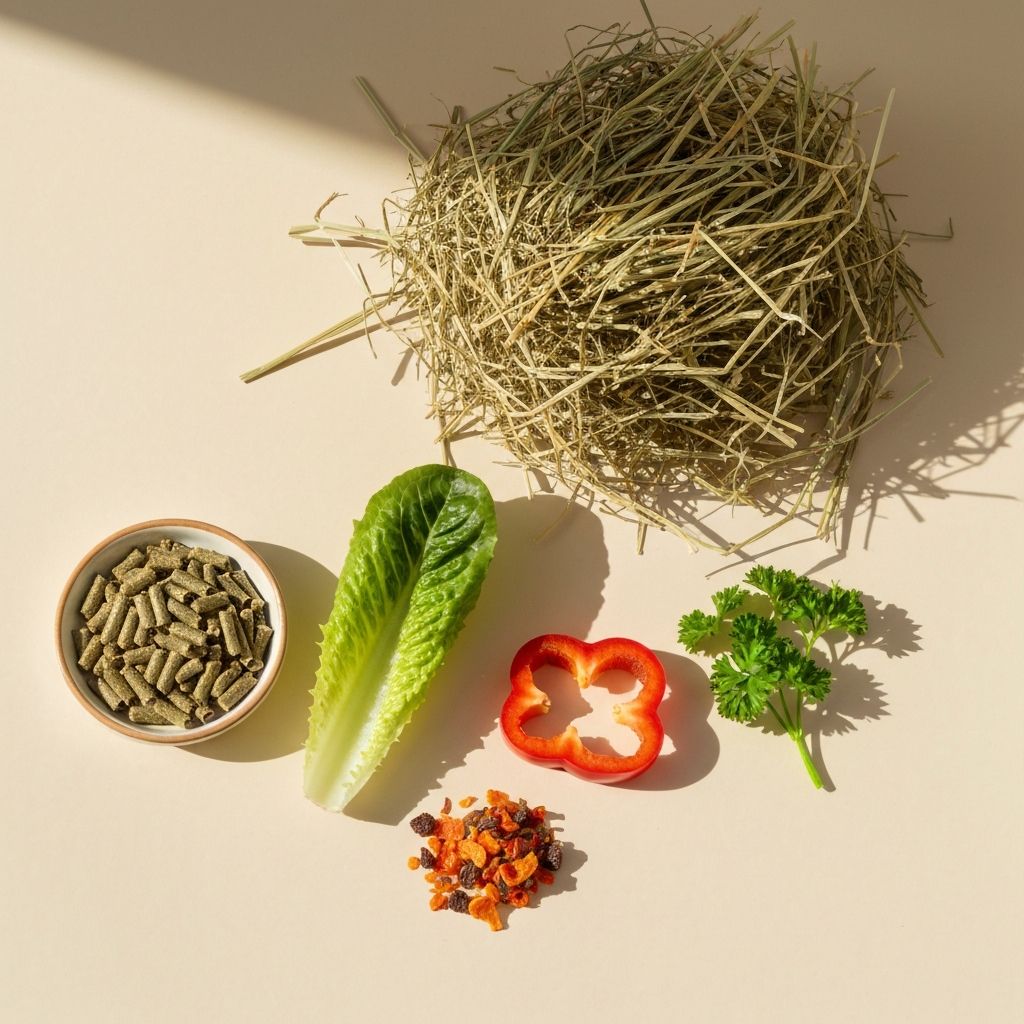
Every day, a guinea pig needs unlimited fresh hay, a small measured portion of pellets, a cup-sized serving of fresh leafy vegetables, and constant access to clean water. Fruit is an occasional treat, not a daily food. That is the whole plan. The detail is in making each part consistent.
Hay first — always
Roughly 80–85% of a guinea pig's diet should be hay, and it should be available at all times. Not topped up once a day and left to deplete. Available, fresh, and plentiful, all day and night. Guinea pigs are grazing animals with a digestive system that depends on continuous fibre movement to function. When hay runs low, gut motility slows. When gut motility slows, problems follow.
Timothy hay is the most widely recommended choice for adult guinea pigs. Meadow hay and orchard grass are good alternatives. Avoid feeding alfalfa hay to adult guinea pigs as a staple — it is higher in calcium and protein and is better suited to pregnant, nursing, or very young animals.
If your guinea pig seems to ignore hay, check its freshness. Hay should smell green and lightly sweet, not dusty, mouldy, or flat. Most guinea pigs that "don't like hay" are being offered something that would not appeal to any sensible animal.
Pellets: a supplement, not the main event
Pellets are not the foundation of the diet — they are a top-up that fills nutritional gaps that hay and vegetables cannot fully cover, particularly vitamin C. A standard adult guinea pig needs around one to two tablespoons of plain, vitamin C-fortified pellets per pig per day. Not a bowl refilled whenever it looks low.
Use plain pellets, not muesli-style mixes. Muesli mixes allow selective feeding — guinea pigs pick out the sweet bits and ignore the nutritious ones. Plain compressed pellets mean every bite is the same.
| Food | Daily amount | When | Notes |
|---|---|---|---|
| Hay | Unlimited | All times | Must never run out |
| Pellets | 1–2 tbsp per pig | Once daily | Plain, not muesli-style |
| Fresh veg | Large handful per pig | Once or split across two meals | Mainly leafy greens |
| Water | Fresh, unlimited | All times | Clean bottle or heavy bowl daily |
| Fruit | Thumbnail-sized piece | 2–3x per week max | Optional treat only |
Fresh vegetables: the daily variety
Aim for roughly a large handful of fresh vegetables per guinea pig per day. The key is variety across the week rather than the same things every day — different greens offer different nutrients, and rotating prevents any single food dominating the diet.
Good daily or near-daily options include romaine lettuce, green leaf lettuce, curly kale, fresh herbs like parsley and coriander, and cucumber. Red or yellow bell pepper is one of the best vitamin C sources available and most guinea pigs eat it enthusiastically — include it most days in a small amount.
Foods to rotate in rather than offer daily include spinach, spring greens, and Swiss chard — these are nutritious but contain oxalic acid or calcium in amounts that matter when given every single day. A little, regularly, rather than a lot, daily.
Our full feeding guide has a detailed breakdown of which vegetables work well and how to think about variety. If you are setting up your new guinea pig setup for the first time, the feeding guide is the place to start.
Fresh water, changed daily
This is the one that owners most consistently underestimate. Guinea pigs need access to clean, fresh water at all times. Not the same water that has been sitting in the bottle since Tuesday. A water bottle or heavy ceramic bowl, rinsed and refilled every day, checked to make sure it is actually dispensing.
A guinea pig that is not drinking enough tends to eat less, has harder droppings, and becomes lethargic. Dehydration in small animals escalates faster than most owners expect.
Foods to avoid entirely
Some foods are genuinely toxic to guinea pigs. Keep these away completely: onion, garlic, chives, leeks, rhubarb, avocado, potatoes, uncooked beans, and anything in the nightshade family beyond ripe tomatoes. Iceberg lettuce is not toxic but has almost no nutritional value and a high water content that can cause loose stools. Processed human food of any kind — crackers, bread, anything with sugar or salt — has no place in a guinea pig's diet.
A simple morning and evening routine
You do not need to be precise to the minute, but building feeding into a routine helps you notice when something is off.
Morning: Check and top up hay. Refill water. Offer fresh vegetables. Remove any uneaten veg from the previous evening if it is looking tired.
Evening: Top up hay again. Offer pellets. Offer a second small veg portion if your schedule allows it. Quick visual check on each pig — appetite, droppings, behaviour.
The evening check is where you spot early signs of digestive issues. A change in droppings is often the first signal that something in the daily care routine needs attention, or that the diet needs adjustment. Our guide on what to do if stools change covers the warning signs to know.
The most common daily feeding mistakes
Too much fruit, offered too often. Muesli-style pellet mixes that encourage selective feeding. Vegetables that are cold from the fridge — let them come to room temperature first. Ignoring hay consumption and not noticing when a guinea pig is eating significantly less of it. Topping up pellets without measuring, so the pig eats far more than they need.
None of these are catastrophic in isolation, but they compound. A diet that is consistently too sugary, too low in hay, or too calorific leads to a guinea pig who is overweight, vitamin C-deficient, or both. Neither condition announces itself loudly — which is exactly why the vitamin C guide is worth reading alongside this one.
Frequently asked questions
How much hay should a guinea pig eat per day?
There is no fixed gram measurement — hay should simply be available at all times and never run out. A healthy guinea pig will work through a generous portion daily. If hay is disappearing quickly, that is a good sign.
Can I feed guinea pigs once a day?
You can offer vegetables and pellets once a day, but hay and water must be available continuously. Once-a-day feeding for hay is not sufficient — it will run out, and your guinea pig will go without between refills.
Do guinea pigs need supplements on top of their food?
A diet that includes vitamin C-fortified pellets and fresh leafy vegetables should cover vitamin C needs without supplementation for most healthy adults. Do not add vitamin C drops to water bottles — the vitamin degrades rapidly on contact with water and the dosage is unpredictable. Food-based vitamin C is always preferable.
How often should I change my guinea pig's water?
Every day, without exception. Rinse the bottle or bowl, refill with fresh water, check the spout is dispensing freely. Stale water is ignored by many guinea pigs and can harbour bacteria.
Can guinea pigs share food with rabbits?
They can eat many of the same fresh vegetables, but rabbit pellets are not suitable for guinea pigs — they do not contain added vitamin C. Always feed species-specific pellets.