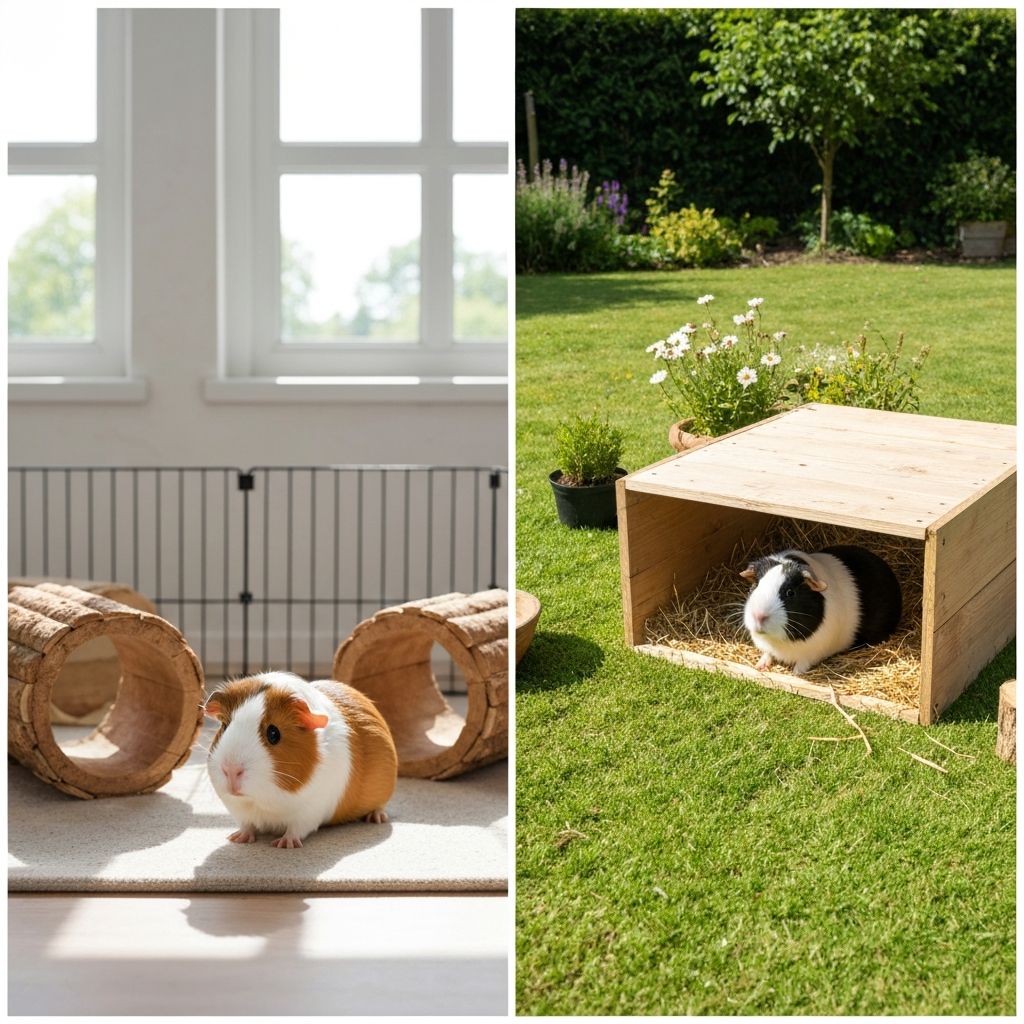
The indoor versus outdoor question comes up constantly in guinea pig discussions, and the honest answer is that both can work well. Both can also be badly done. What matters is not which side of the door your guinea pigs are on, but whether their environment is actually safe, stable, and well managed for UK conditions.
This is the realistic version of that comparison.
The case for indoor guinea pigs
Indoor living gives you some significant advantages in a British climate:
Temperature stability
The UK weather is erratic. Indoor guinea pigs are protected from sudden heat, unexpected cold snaps, and the kind of damp that creeps into outdoor structures over winter. You have control over the environment.
Closer observation
When your guinea pigs share your living space, you see them more often. Small changes in appetite, movement, or behaviour are easier to catch early when the animals are part of your daily visual field. This matters.
Stronger bonds
Proximity helps. Guinea pigs who are around people regularly tend to become more comfortable with human presence, more vocal, and more interactive. That is good for welfare and good for the relationship.
The trade-offs
Indoor setups take up real domestic space. Hay is everywhere. Ventilation matters. Guinea pigs are not silent. The smell of a poorly maintained indoor enclosure is hard to ignore. If you cannot genuinely accommodate a properly sized setup inside, forcing it indoors is not a welfare gain.
The case for outdoor guinea pigs
Outdoor setups can work brilliantly when they are designed properly.
More natural behaviour
Access to fresh grass, natural light, and varied outdoor stimuli adds genuine enrichment. Guinea pigs who can graze safely on good grass are doing something very close to what their ancestors did. That is not nothing.
More space
Outdoor runs and sheds often allow for larger overall footprints than is practical indoors. A properly set-up outbuilding with a connected run can give guinea pigs far more room than any indoor setup in a typical UK home.
The trade-offs
Outdoor guinea pigs require a serious commitment to weather management. UK summers can become dangerously hot. UK winters bring damp, cold, and sometimes frozen water. Fly risk in warm months is real, especially for pigs with hygiene issues. Predator security must be reliable every single night, not just most nights.
Outdoor pigs need the same daily observation as indoor pigs, but the friction of going outside to check on them means some owners do it less consistently. That is a welfare risk.
What makes the real difference
The single most important factor in this comparison is not location. It is management.
An indoor guinea pig in a small cage who is rarely checked, rarely cleaned, and living in a dusty corner is in a worse situation than an outdoor guinea pig in a spacious, secure, weather-managed shed with twice-daily checks.
Conversely, an outdoor guinea pig left in a summer shed with no shade and no ventilation while the temperature climbs past 28 degrees is in an emergency, regardless of how spacious the setup is.
The hybrid approach
Many experienced UK guinea pig owners use a hybrid model: indoor for most of the year, outdoor run for supervised daytime grazing in good summer weather, and a move to a more protected indoor space during cold, damp, or extreme conditions.
This is often the most practical approach for guinea pigs who started life indoors but benefit from seasonal access to grass.
The practical checklist
Whichever setup you choose, make sure it delivers:
- enough floor space for the number and size of your guinea pigs
- stable, manageable temperatures year-round
- predator security if any outdoor access is involved
- daily observation as part of a real routine
- easy cleaning access
- protection from draughts, damp, and direct sun
For the details of outdoor shed setups, read Sheds. For year-round weather planning, see Seasonal Care. For housing size and layout basics, visit Hutches and Cages.